
Complete History of the Nintendo 64
The Nintendo 64 revolutionized the gaming industry by proving that fully 3D worlds were not only possible but incredibly fun to explore. Developed through a historic partnership between Nintendo and Silicon Graphics, the journey of the N64 from its early "Project Reality" codename to becoming a staple of 90s living rooms is a masterclass in hardware innovation. By taking bold risks—like pioneering the analog stick and sticking with cartridge formats—Nintendo paved a unique path that forever changed how video games are played.
For gaming enthusiasts looking to brush up on their retro knowledge with zero fluff, here is the complete, fact-driven timeline of the console that defined a generation.
Key Takeaways (2026)
- August 1993: Nintendo officially announces "Project Reality" in collaboration with Silicon Graphics.
- June 23, 1996: The Nintendo 64 officially launches in Japan, followed by North America in September.
- Hardware Innovation: The system popularized the thumb-operated analog stick and built-in four-player local multiplayer.
- Media Format: Nintendo famously stuck to ROM cartridges for faster load times and anti-piracy, while competitors adopted CD-ROMs.
- Market Impact: Despite losing third-party support to Sony's PlayStation, it sold nearly 33 million units globally.
- Legacy: Titles like Super Mario 64 and The Legend of Zelda: Ocarina of Time laid the foundational rules for modern 3D game design still used today.
Disclaimer: The links provided herein are affiliate links. If you choose to use them, I may earn a commission from the platform owner, at no extra cost to you. This helps support my work and allows me to continue to provide valuable content. Thank you!
Project Reality and the Genesis of 64-Bit Power
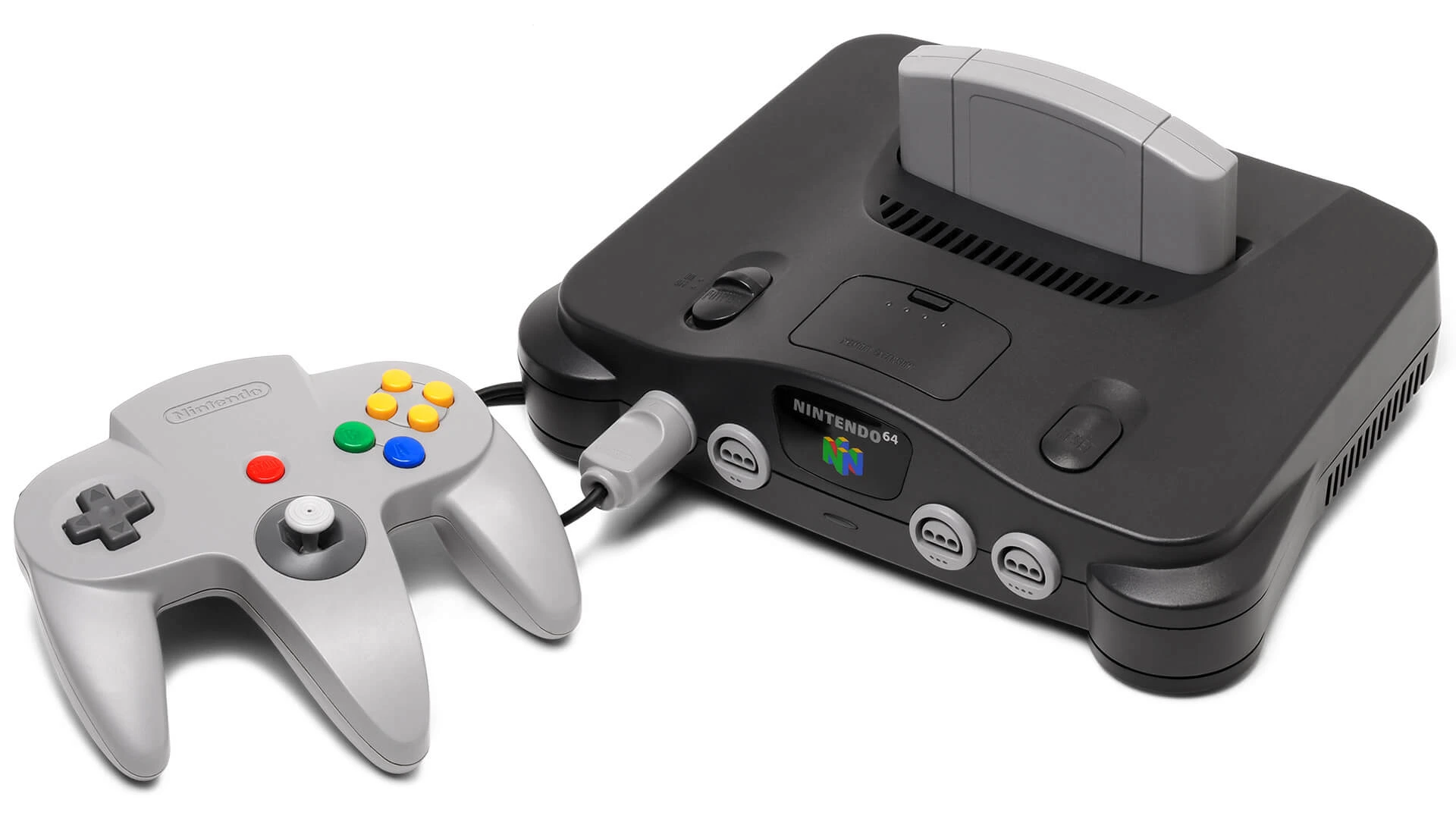
In the early 1990s, the transition from 2D sprites to 3D polygons was becoming inevitable. While competitors were launching 32-bit systems, Nintendo decided to leapfrog the competition. In 1993, they partnered with Silicon Graphics (SGI), a company renowned for high-end visual computing, to create a 64-bit powerhouse codenamed "Project Reality."
The goal was ambitious: to deliver arcade-quality 3D graphics in a home console for under $250. Originally slated to be called the "Ultra 64," the name was eventually simplified to the Nintendo 64 to ensure global trademark consistency. The console was delayed several times to allow developers, particularly Nintendo's own teams, to master the complex new hardware and polish the launch titles to perfection.
The Controller that Changed Everything

When the system finally launched in the summer of 1996, one of its most striking features was its unique, trident-shaped controller. While it looked unconventional, it was engineered specifically for 3D navigation. By placing an analog thumbstick in the center prong, Nintendo gave players precise, 360-degree control over characters in 3D space—an absolute necessity for their killer app, Super Mario 64.
Furthermore, the controller featured a trigger on the back (the Z-button), mimicking the feel of a grip, and the console natively supported four controller ports. This out-of-the-box four-player functionality turned the N64 into the ultimate party machine, paving the way for legendary multiplayer sessions in GoldenEye 007, Mario Kart 64, and Super Smash Bros.
The Cartridge Controversy

The most polarizing decision of the Nintendo 64's history was the retention of the ROM cartridge format. While Sony's PlayStation and Sega's Saturn moved to CD-ROMs—which held vastly more data and were incredibly cheap to manufacture—Nintendo stood its ground. Cartridges offered virtually non-existent load times, were highly durable, and made piracy exceedingly difficult.
However, this decision came at a steep cost. Cartridges were expensive to produce, limiting profit margins and scaring away critical third-party developers like Square, who famously moved Final Fantasy VII to the PlayStation due to the storage requirements for pre-rendered cinematic cutscenes. Despite this, Nintendo's masterful first-party output and a strong partnership with Rareware kept the console highly competitive.
Enduring Legacy
Production of the Nintendo 64 officially ceased in 2002 to make way for the GameCube, closing out its lifecycle with nearly 33 million units sold. While it didn't win the sales war of its generation, its impact on game design is arguably unmatched.
The N64 taught the industry how to handle a 3D camera, how to implement an analog stick effectively, and how to utilize a Z-targeting lock-on system (introduced in Ocarina of Time). Today, the console is celebrated as a retro powerhouse, with its games continually preserved and played through digital storefronts and modern emulation, securing its status as a foundational pillar of modern gaming.
Frequently Asked Questions
When was the Nintendo 64 officially released?
The Nintendo 64 was first released in Japan on June 23, 1996, followed by North America on September 29, 1996, and Europe and Australia in March 1997.
Why did the Nintendo 64 use cartridges instead of CDs?
Nintendo chose ROM cartridges primarily to eliminate loading times, maintain hardware durability, and heavily deter software piracy, despite the fact that it limited storage capacity and alienated some third-party developers.
What were the launch titles for the Nintendo 64?
In Japan, the console launched with three games: Super Mario 64, Pilotwings 64, and Saikyō Habu Shōgi. In North America, it launched with just two: Super Mario 64 and Pilotwings 64.
Author Details

Mazen (Mithrie) Turkmani
I have been creating gaming content since August 2013, and went full-time in 2018. Since then, I have published hundreds of gaming news videos and articles. I have had a passion for gaming for more than 30 years!
Ownership and Funding
Mithrie.com is a Gaming News website owned and operated by Mazen Turkmani. I am an independent individual and not part of any company or entity.
Advertising Policy
Mithrie.com is supported by advertising revenue to sustain independent gaming journalism. We utilize partners such as Google AdSense and may work with other ad networks in the future. Editorial content remains objective and is not influenced by advertisers or sponsorships unless explicitly stated.
Use of Automated Content
Mithrie.com uses AI tools (including ChatGPT and Google Gemini) to assist in structuring and formatting content. All news stories are fact-checked, edited, and verified by Mazen Turkmani to ensure accuracy and journalistic integrity.
News Selection and Presentation
The news stories on Mithrie.com are selected by me based on their relevance to the gaming community. I strive to present the news in a fair and unbiased manner.