
The Complete History of Nintendo Consoles (1977-2026)
The recent blockbuster launch of the Nintendo Switch 2 is not just another hardware release; it is the culmination of nearly five decades of unyielding innovation. From their humble beginnings manufacturing hanafuda playing cards to dominating the global entertainment landscape, Nintendo's journey is a fascinating narrative of monumental risks, business rivalries, and an unwavering commitment to pure, unadulterated fun.
To truly understand the design philosophy behind the Switch 2 that players are currently enjoying, we must look backward. This definitive retrospective traces Nintendo's hardware lineage from the 1970s up to 2026, chronicling the studio origins, the creation of their biggest rivals, the supremacy of their handhelds, and the enduring legacies that reshaped the gaming industry forever.
Key Takeaways (2026)
- 1977-1983: Nintendo enters the hardware market with the Color TV-Game and revives the crashed Western gaming industry with the Famicom/NES.
- The PlayStation Betrayal: A failed CD-ROM partnership with Sony during the SNES era inadvertently birthed Nintendo's greatest rival.
- Handheld Supremacy: From the Game Boy to the DS, Nintendo maintained a multi-decade, undisputed monopoly over portable gaming.
- The 3D Pioneers: Analog sticks and lock-on targeting revolutionize gaming on the N64, though stubborn formats limit market share.
- The Blue Ocean Strategy: The Wii proves that intuitive, motion-controlled fun can outsell raw graphical horsepower.
- The Hybrid Era (2017-Present): The Switch erased the line between home consoles and handhelds, paving the foundation for the newly released Nintendo Switch 2.
Disclaimer: The links provided herein are affiliate links. If you choose to use them, I may earn a commission from the platform owner, at no extra cost to you. This helps support my work and allows me to continue to provide valuable content. Thank you!
The Color TV-Game & The 8-Bit Savior (1977-1990)
Nintendo's very first foray into the home console space was the Japan-exclusive Color TV-Game series in 1977. Created in partnership with Mitsubishi Electronics, these dedicated consoles featured built-in variations of Pong. While primitive, they provided Nintendo with vital experience in electronic manufacturing, selling approximately 3 million units.
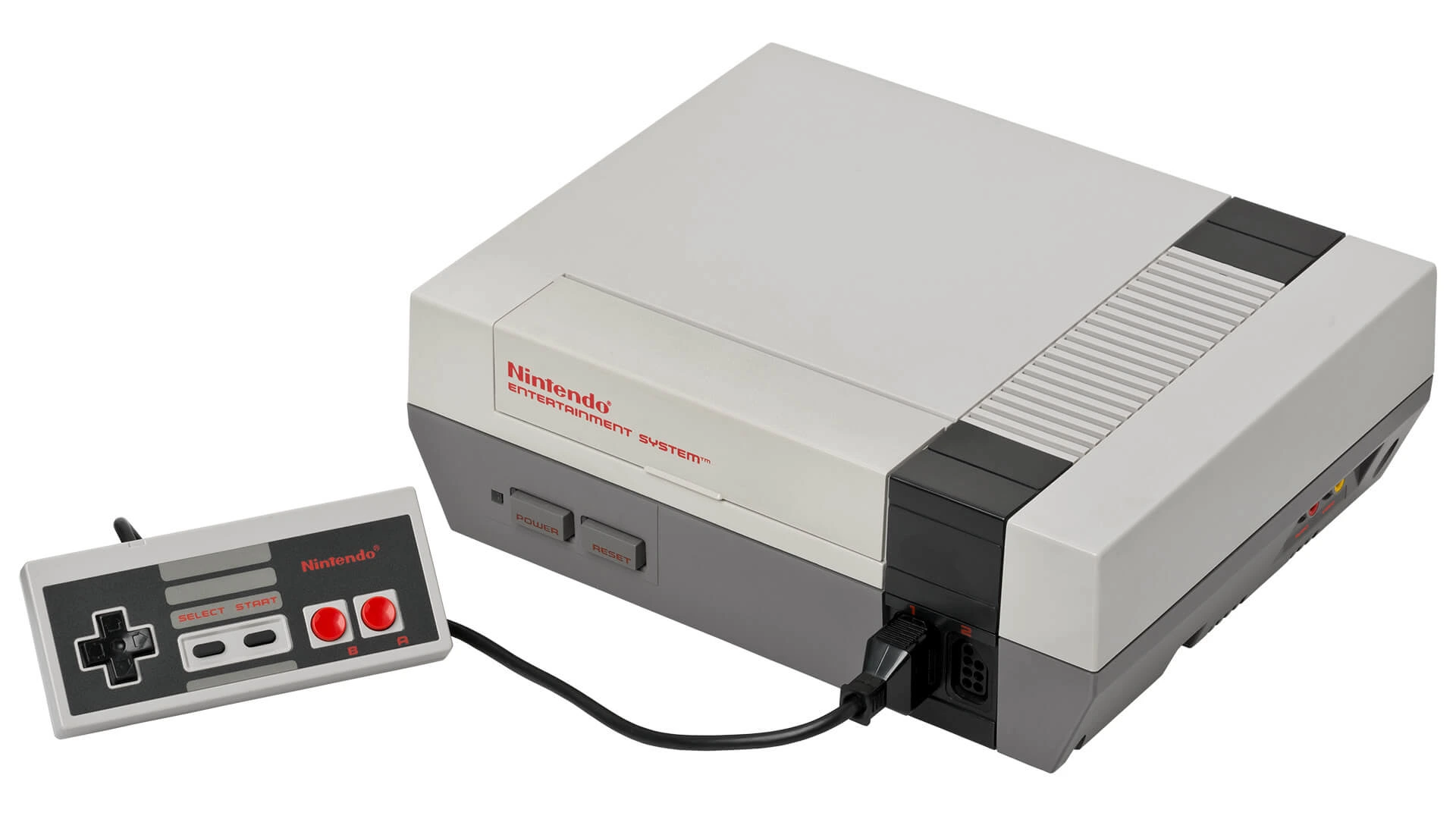
The true paradigm shift occurred in 1983 with the release of the Family Computer (Famicom) in Japan. The system was a smash hit, but the North American video game crash of 1983 had left Western retailers deeply skeptical of video games. Nintendo cleverly redesigned the Famicom into the Nintendo Entertainment System (NES) for its 1985 Western launch. By packaging it with R.O.B. (Robotic Operating Buddy), they marketed it as a high-tech toy rather than a traditional console. Through rigid quality control via the "Nintendo Seal of Quality" and masterpieces like Super Mario Bros., the NES effectively saved the Western gaming industry from collapse, selling a staggering 61.91 million units worldwide.
The 16-Bit Era & The Sony Betrayal (1990-1995)

The 1990s introduced fierce competition with Sega, but Nintendo's Super Nintendo Entertainment System (SNES) ultimately won the 16-bit console war, securing 49.10 million unit sales. However, the SNES era is perhaps most famous for the business blunder that created modern gaming's biggest rivalry.
Seeking to embrace emerging optical media, Nintendo partnered with Sony to develop a CD-ROM add-on for the SNES, colloquially known as the "Nintendo PlayStation". However, Nintendo executives grew fearful that the contract gave Sony too much control over software licensing rights. In a shocking move at the 1991 Consumer Electronics Show, Nintendo publicly announced they were abandoning Sony to partner with Philips instead. A furious and scorned Sony decided to take their prototype, refine it, and release it as a standalone console in 1994: the original PlayStation. Nintendo had inadvertently created a juggernaut rival.
The Undisputed Kings of Handheld Gaming (1989-2011)

While Nintendo fought bitter wars in the living room, they maintained an absolute, iron-fisted monopoly in players' pockets. Released in 1989, the Game Boy (and its subsequent Color iteration) traded graphical fidelity for incredible battery life and durable design, moving an astounding 118.69 million units largely thanks to Tetris and the global phenomenon of Pokémon.
The handheld dynasty continued uninterrupted with the 32-bit Game Boy Advance in 2001 (81.51 million units). However, their greatest hardware triumph arrived in 2004 with the dual-screen Nintendo DS. Bringing touch controls to the masses, the DS appealed to both hardcore gamers and casual demographics, becoming Nintendo's best-selling console of all time at 154.02 million units. Even as smartphones began to rise, the stereoscopic Nintendo 3DS (2011) proved highly successful with 75.94 million units sold, proving Nintendo's unmatched mastery of portable play.
The 3D Era, Storage Wars & The GameCube (1996-2001)

Back in the living room, the industry was transitioning into the polygonal 3D era. Nintendo forged a partnership with Silicon Graphics to create a 64-bit powerhouse. If you are curious about this specific era of innovation, you can read more in our Complete History of the Nintendo 64. However, Nintendo's stubborn loyalty to expensive ROM cartridges alienated crucial third-party developers like Square, allowing Sony's CD-based PlayStation to seize massive market share. The legendary N64 finished its lifecycle with 32.93 million units sold.
Determined to correct course, Nintendo launched the GameCube in 2001, finally adopting optical media—albeit proprietary mini-DVDs to thwart piracy. For a deep dive into this beloved, lunchbox-shaped console's library, check out our Complete History of the Nintendo GameCube. Despite being more powerful than the PlayStation 2, the GameCube struggled commercially. The GameCube ultimately sold 21.74 million units, making it evident that Nintendo could no longer win by simply competing on raw graphical horsepower.
The Blue Ocean Strategy & Hybrid Revolution (2006-2017)

In 2006, under the leadership of Satoru Iwata, Nintendo executed a "Blue Ocean Strategy" with the Wii. Instead of fighting Microsoft and Sony for hardcore gamers, they targeted the untapped casual market with intuitive motion controls. The gamble paid off spectacularly, making gaming a family-room staple and achieving an extraordinary 101.63 million units sold. However, the subsequent Wii U (2012) suffered an identity crisis. Its confusing marketing left consumers unsure if it was a new console or a peripheral, resulting in the system becoming a commercial failure, moving only 13.56 million units worldwide.
Nintendo retreated, iterated, and struck gold in 2017 with the Nintendo Switch. By combining their dominant handheld lineage with home console capabilities, they created a flawless hybrid system. Powered by an Nvidia Tegra chip, the console played host to incredible first-party software. Fans looking for the absolute pinnacle of this era can explore the Best Mario Games for Nintendo Switch, or read our complete Nintendo Switch 2026 Guide: Specs, Top Games & Ecosystem Status to see how the platform evolved before its successor arrived. The original console became a cultural phenomenon, becoming one of the best-selling consoles in history with over 146 million units sold by early 2026.
The Arrival of the Nintendo Switch 2 (2026)

By the time 2026 rolled around, the original Switch's aging hardware was visibly struggling with complex, modern third-party titles. The industry demanded a successor, and Nintendo finally delivered. Released earlier this year to massive fanfare, the Nintendo Switch 2 safely built upon the massive success of the hybrid formula, opting for smart evolution over risky revolution. As of today, the console has already cleared over 5 million units sold in its early launch window, proving the hybrid demand remains exceptionally strong.
Now firmly in the hands of millions of gamers worldwide, the Switch 2 directly addresses the bottlenecks of its predecessor. With a significantly upgraded internal architecture, enhanced resolution outputs, and a refined Joy-Con connection system that eliminates historical hardware drifts, it bridges the gap with contemporary fidelity. More importantly, it respects the massive digital libraries players built over the previous decade via backward compatibility. The Nintendo Switch 2 is not just a new piece of hardware; it is the refined, powerful embodiment of Nintendo's fifty-year quest to perfect the art of play.
Frequently Asked Questions
What was Nintendo's very first video game console?
Nintendo's first foray into home video game consoles was the Color TV-Game series, released exclusively in Japan starting in 1977.
What is Nintendo's best-selling console of all time?
The Nintendo DS is the company's best-selling hardware of all time, moving an astounding 154.02 million units worldwide, followed closely by the Nintendo Switch.
Why did Nintendo and Sony split up over the PlayStation?
Nintendo originally partnered with Sony to build a CD-ROM add-on for the SNES dubbed the "Nintendo PlayStation". Fearing Sony would hold too much power over software licensing rights, Nintendo secretly backed out to partner with Philips. The betrayal prompted Sony to release their own standalone console, creating Nintendo's biggest rival.
Why did the Nintendo Switch format succeed where the Wii U failed?
The Wii U suffered from confusing marketing and a clunky dual-screen setup. The Switch succeeded by streamlining the concept into a single, truly portable hybrid device with a clear, unified marketing message.
How does the recently released Nintendo Switch 2 compare to previous generations?
Now in players' hands, the Nintendo Switch 2 builds upon the successful hybrid foundation of its predecessor, offering enhanced internal architecture, backward compatibility, and processing power to bridge the gap with contemporary high-fidelity gaming while maintaining its signature portability.
Author Details

Mazen (Mithrie) Turkmani
I have been creating gaming content since August 2013, and went full-time in 2018. Since then, I have published hundreds of gaming news videos and articles. I have had a passion for gaming for more than 30 years!
Ownership and Funding
Mithrie.com is a Gaming News website owned and operated by Mazen Turkmani. I am an independent individual and not part of any company or entity.
Advertising Policy
Mithrie.com is supported by advertising revenue to sustain independent gaming journalism. We utilize partners such as Google AdSense and may work with other ad networks in the future. Editorial content remains objective and is not influenced by advertisers or sponsorships unless explicitly stated.
Use of Automated Content
Mithrie.com uses AI tools (including ChatGPT and Google Gemini) to assist in structuring and formatting content. All news stories are fact-checked, edited, and verified by Mazen Turkmani to ensure accuracy and journalistic integrity.
News Selection and Presentation
The news stories on Mithrie.com are selected by me based on their relevance to the gaming community. I strive to present the news in a fair and unbiased manner.