
Definitive Ranking of Each Title in the Assassin's Creed Series
The Assassin's Creed franchise, published by Ubisoft, has fundamentally defined the historical action-adventure genre. If you want a complete breakdown of their expansive library, check out our 🎮 Ubisoft Entertainment Game Hub. The series has sold over 200 million copies as of late 2022, securing its position as one of the best-selling video game series in history.
Each game plunges players into the everlasting war between the Assassins and the Templars. By blending deep historical narratives with constantly evolving stealth and RPG mechanics, the series has consistently delivered engaging experiences across various eras.
This guide ranks each title to help veterans and newcomers identify the absolute best and most underrated games in the franchise. We get straight to the facts regarding gameplay evolution, standout protagonists, and what makes each entry unique.
Key Takeaways
- The series is built on a fictional narrative centered around the conflict between the Assassin Brotherhood and the Templar Order, utilizing real historical backdrops and figures.
- Gameplay has evolved dramatically, shifting from pure stealth-based action to expansive open-world RPGs with sophisticated combat systems and naval warfare.
- Assassin's Creed extends far beyond gaming, with major adaptations in films, books, comics, and anime, while also serving as a popular educational tool for history.
Disclaimer: The links provided herein are affiliate links. If you choose to use them, I may earn a commission from the platform owner, at no extra cost to you. This helps support my work and allows me to continue to provide valuable content. Thank you!
Exploring the Assassin's Creed Universe
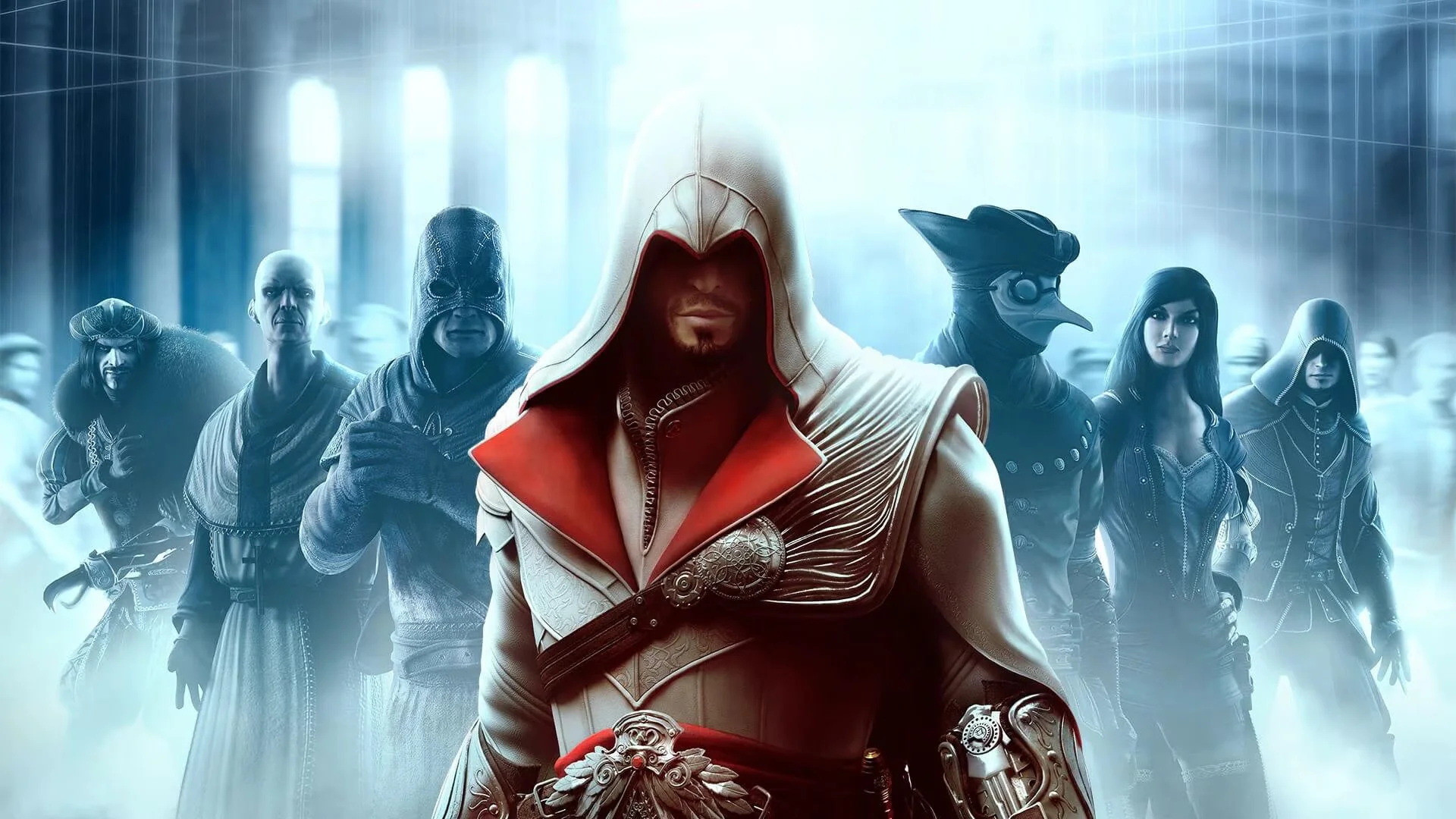
The Assassin's Creed universe seamlessly blends history and fiction. Assassin's Creed Brotherhood, set in Renaissance Italy, heavily expanded this narrative by formally introducing the Brotherhood of Assassins, tasking players with recruiting and training new initiates to fight alongside them.
Players typically control a historical Assassin while navigating a present-day framing story involving the modern Assassin–Templar conflict.
The Brotherhood and the Templar Order
The ideological war between the liberty-seeking Assassin Brotherhood and the order-driven Templar Order drives the franchise. This conflict is the baseline for every game, from the deserts of Assassin's Creed Origins to the Norse expansions of Assassin's Creed Valhalla.
Characters like Ezio Auditore (Master Assassin) and Shay Cormac (Assassin-turned-Templar) showcase the complexity of this feud. Assassin's Creed Rogue explicitly flips the script, detailing Shay Cormac's betrayal of the Brotherhood and offering players a rare perspective from the Templar side.
Historical Settings and Their Significance
The franchise meticulously reconstructs historical eras. The original 2007 game was set in the Holy Land during the Third Crusade, spanning Jerusalem, Acre, and Damascus. Since then, the series has released fourteen main installments covering massively distinct time periods.
Assassin's Creed III takes players to the American Revolution, while Assassin's Creed Unity introduces cooperative multiplayer to the dense, chaotic streets of 18th-century Paris during the French Revolution. Historical figures, like Leonardo da Vinci in Assassin's Creed II, provide mission context and vital equipment upgrades.
Present-Day Storylines: Connecting Past and Future
The modern-day narrative revolves around Abstergo Industries, a corporate front for the Templar Order. Abstergo utilizes the Animus—a machine that allows users to relive the genetic memories of their ancestors.
Recent protagonists like Layla Hassan (in Odyssey and Valhalla) use the Animus to uncover Isu artifacts and ancient secrets to prevent modern-day catastrophes, linking the historical gameplay directly to the present.
The Evolution of Gameplay Mechanics

The franchise has shifted significantly from a tight, stealth-focused action game to a massive, open-world RPG. These third-person games now offer hundreds of hours of exploration, branching dialogue, and robust skill trees.
From Stealth to Open World Exploration

Early games demanded social stealth—blending into crowds and remaining undetected. Recent entries like Origins, Odyssey, and Valhalla prioritized enormous open worlds with complex side quests. Additionally, naval combat, introduced in Assassin's Creed III and perfected in Assassin's Creed IV: Black Flag, became a defining feature for a massive era of the franchise.
Combat Innovations and RPG Elements

Combat transitioned from reaction-based counterattacks to a hitbox-based system in Origins. Players now manage stamina, execute parries, and utilize diverse weaponry ranging from heavy axes to blowpipes. The modern RPG entries grant players the ability to level up gear, unlock targeted abilities, and shape the narrative through dialogue choices.
Parkour and Environmental Interaction
Parkour remains a core mechanic. Over the years, traversal has smoothed out, transitioning from rigid building-climbing to the fluid tree-running introduced in Assassin's Creed III. Social stealth remains a viable option in city-centric games like Mirage, allowing players to utilize the iconic Hidden Blade from the shadows.
The Best Assassin's Creed Games Critically Appraised
Certain titles have defined not just the franchise, but the action-adventure genre as a whole, earning multiple Game of the Year awards and nominations.
Top Picks: The Pinnacle of the Series
Assassin's Creed II is widely considered the peak of the classic era, introducing Ezio Auditore and vastly improving upon the original game's repetitive structure. Assassin's Creed Brotherhood perfected this formula.
Later, Assassin's Creed Syndicate introduced distinct dual protagonists (Jacob and Evie Frye) and a grappling hook that revolutionized traversal in 19th-century London.
Underrated Gems: Overlooked Entries
Assassin's Creed Rogue remains highly underrated. By putting players in control of a Templar, it answers long-standing lore questions and features an excellent blend of the land combat from AC III and the naval combat of Black Flag.
Iconic Protagonists
The protagonists are just as famous as the historical settings they inhabit. Armed with the iconic spring-loaded Hidden Blade, these characters carry the emotional weight of the series.
Ezio Auditore: The Heart of the Renaissance
Ezio Auditore da Firenze is the undisputed face of the franchise. By spanning three full games (II, Brotherhood, Revelations), players experience his entire life cycle, from a brash nobleman to a wise Mentor of the Brotherhood.
Other Notable Assassins
Edward Kenway from Black Flag perfectly executes the "pirate-turned-assassin" arc. Bayek of Siwa in Origins provides a deeply emotional performance as a grieving father who inadvertently founds the Hidden Ones (the precursors to the Assassins).
Community Engagement and Events
Ubisoft heavily supports the Assassin's Creed community via live events, social media campaigns, and active forums. Fan festivals and cosplay events frequently feature developers offering sneak peeks at upcoming DLCs, like during the annual Ubisoft Forward showcases.
Future Horizons: What's Next for Assassin's Creed?
The franchise is undergoing a massive structural shift. As of February 2026, Ubisoft confirmed that the leadership team behind 2013's critically acclaimed Assassin's Creed IV: Black Flag—Martin Schelling, Jean Guesdon, and François de Billy—are now in charge of stewarding the entire series under Vantage Studios, a newly launched subsidiary partly funded by Tencent.
Upcoming Titles and Innovations
Assassin's Creed Shadows plunges players into the Sengoku period of Japan, featuring dual protagonists: Naoe (a shinobi) and Yasuke (the historical African samurai).
The Infinity Hub
Assassin's Creed Infinity (now integrated as the Animus Hub) is the new live-service launcher. It functions as a centralized gateway connecting all future installments, beginning with Shadows, fundamentally changing how players access new content.
Assassin's Creed Beyond Gaming
The 2016 live-action Assassin's Creed film starring Michael Fassbender successfully replicated the games' parkour and aesthetic but was a massive box office failure, losing up to $100 million due to a convoluted, exposition-heavy plot. Ubisoft has since pivoted to animation, including an upcoming Netflix anime series, alongside a vast library of extended lore novels and comic books.
Summary
From the groundbreaking social stealth of the 2007 original to the sprawling RPG mechanics of modern entries, Assassin's Creed remains a titan of the gaming industry. With the original Black Flag leadership team now at the helm of Vantage Studios, the franchise's future looks to recapture its classic prestige while pushing the boundaries of historical action-adventure.
Author Details

Mazen (Mithrie) Turkmani
I have been creating gaming content since August 2013, and went full-time in 2018. Since then, I have published hundreds of gaming news videos and articles. I have had a passion for gaming for more than 30 years!
Ownership and Funding
Mithrie.com is a Gaming News website owned and operated by Mazen Turkmani. I am an independent individual and not part of any company or entity.
Advertising Policy
Mithrie.com is supported by advertising revenue to sustain independent gaming journalism. We utilize partners such as Google AdSense and may work with other ad networks in the future. Editorial content remains objective and is not influenced by advertisers or sponsorships unless explicitly stated.
Use of Automated Content
Mithrie.com uses AI tools (including ChatGPT and Google Gemini) to assist in structuring and formatting content. All news stories are fact-checked, edited, and verified by Mazen Turkmani to ensure accuracy and journalistic integrity.
News Selection and Presentation
The news stories on Mithrie.com are selected by me based on their relevance to the gaming community. I strive to present the news in a fair and unbiased manner.