
The Complete History of Square Enix: Sales, Mergers & 2026 Future
In a decisive pivot that has actively redefined its trajectory, Square Enix has officially cemented an aggressive Day-1 multi-platform release strategy across PC, Xbox, and Nintendo ecosystems in 2026. This historic shift marks the end of an era heavily reliant on PlayStation console exclusivity, a strategy that defined the studio for nearly three decades but ultimately proved unsustainable in the modern gaming economy.
Understanding this massive corporate shift requires looking back at the publisher's monumental legacy. From their bitter 16-bit rivalries to the transformative 2003 merger, and from near-bankruptcy to unparalleled MMO success, this is the complete history of Square Enix, backed by the latest 2026 financial milestones that explain exactly why the Japanese RPG giant is changing the way we play.
Key Takeaways (2026)
- The Multi-Platform Pivot: A massive $140 million write-down in 2024 forced Square Enix to abandon exclusive payouts in favor of maximizing software sales across PC, Xbox, and Nintendo.
- The 2003 Merger: Former rivals Square and Enix joined forces to survive the escalating costs of 3D game development, forever altering the RPG landscape.
- Franchise Dominance: Final Fantasy reigns supreme at over 207 million units sold, while Dragon Quest commands 95 million units globally.
- The FFXIV Miracle: A catastrophic $100 million loss during the 1.0 era was reversed by Naoki Yoshida, transforming the MMO into the company's most profitable asset.
Disclaimer: The links provided herein are affiliate links. If you choose to use them, I may earn a commission from the platform owner, at no extra cost to you. This helps support my work and allows me to continue to provide valuable content. Thank you!
The 2024-2026 Multi-Platform Pivot
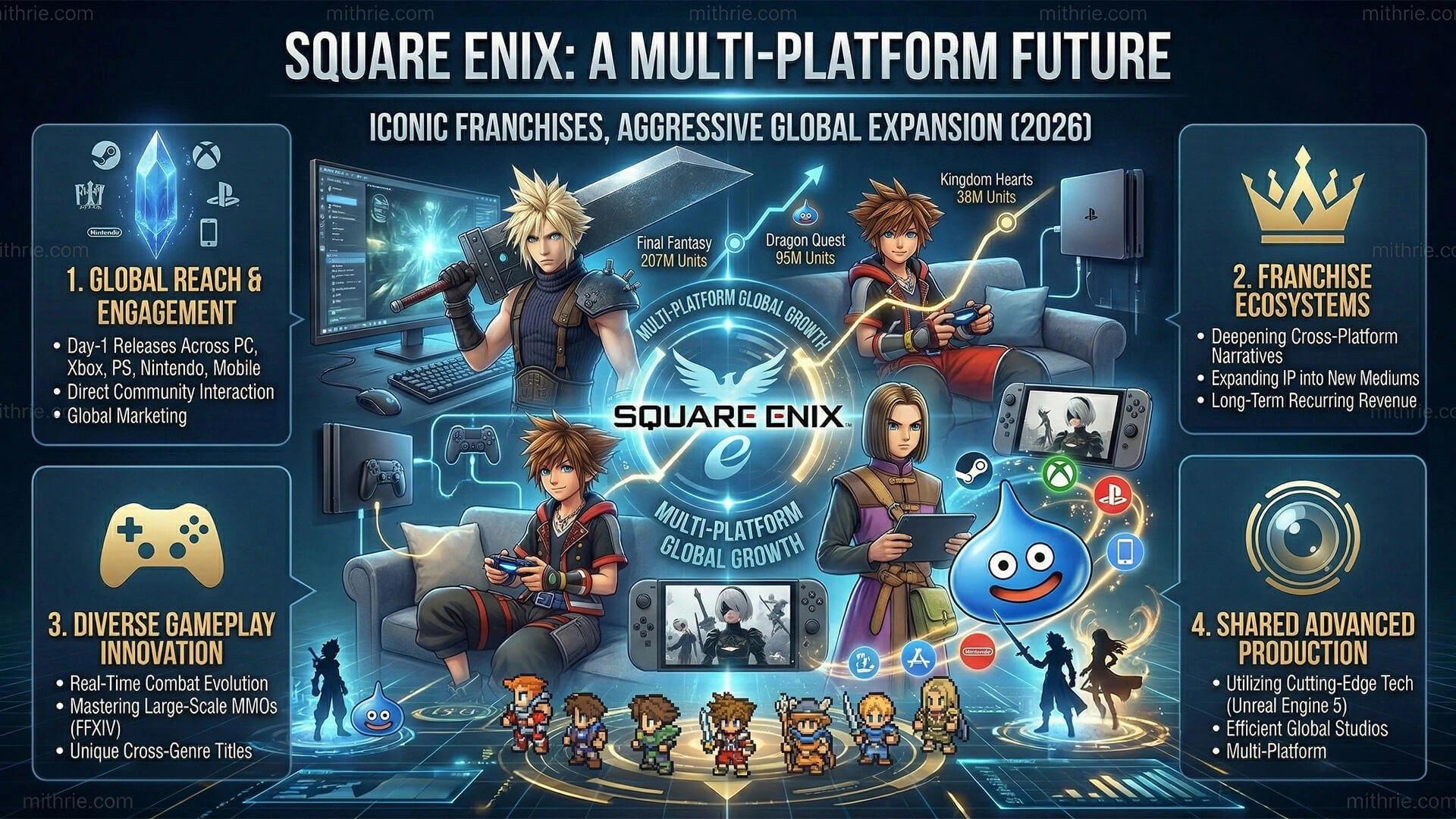
For years, Square Enix's corporate strategy was heavily intertwined with Sony, relying on lucrative PlayStation exclusivity deals for massive flagship titles like Final Fantasy XVI and Final Fantasy VII Rebirth. However, the modern gaming landscape's sprawling development budgets exposed the fatal flaw of restricting player bases.
Failing to meet internal sales targets on exclusive titles culminated in a massive $140 million "content abandonment" write-down in 2024. This wake-up call forced a permanent shift in philosophy. As of 2026, Square Enix has officially pivoted its corporate strategy, aggressively pursuing Day-1 multi-platform releases to ensure that PC, Xbox, and Nintendo players have immediate access to their world-class titles, prioritizing raw software sales over platform payouts.
The 2003 Merger That Changed Gaming

Long before their multi-platform ambitions, Square (Squaresoft) and Enix were the two undisputed titans of the Japanese RPG market. They competed fiercely throughout the 8-bit and 16-bit eras, pushing the boundaries of what storytelling in games could achieve—a legacy thoroughly explored in our deep dive on the evolution of the JRPG genre.
However, the transition into the 3D era of gaming skyrocketed development costs. Following the massive financial failure of Square's 2001 feature film, Final Fantasy: The Spirits Within, the company faced insolvency. In a move that shocked the industry, the former rivals officially merged on April 1, 2003. Combining Enix's outsourcing business model with Square's cutting-edge in-house development studios created a global powerhouse capable of weathering the turbulent decades to come.
Franchise Sales & Financial Pillars

Today, the company's financial stability rests firmly on the shoulders of three defining pillars. By early 2026, the Final Fantasy franchise remains the crown jewel, boasting over 207 million units sold globally. It is the undeniable primary international revenue driver for the publisher.
Meanwhile, Dragon Quest remains a cultural phenomenon. While heavily Japan-centric in its origins, it has achieved over 95 million units sold globally, consistently operating as one of the most profitable RPG series in gaming history. Rounding out the trio is Kingdom Hearts. The beloved Disney crossover property maintains consistent appeal despite spaced-out release cycles, securing over 38 million units sold globally.
The Final Fantasy XIV Miracle
No history of Square Enix is complete without acknowledging one of the greatest redemption arcs in entertainment. In 2010, the original launch of Final Fantasy XIV (1.0) was a catastrophic failure. The MMO was universally panned, resulting in an estimated $100 million in direct and indirect losses, which severely damaged Square Enix's stock, reputation, and consumer trust.
Instead of abandoning the project, Square Enix installed Naoki Yoshida (Yoshi-P) as director. Under his leadership, the game was literally destroyed in-universe and rebuilt from the ground up as A Realm Reborn (2013). Today, aided by incredible expansions detailed in our guide on Mastering Final Fantasy XIV: Dawntrail & Beyond, the game is the company's most profitable ongoing asset. It single-handedly carries the MMO division's recurring revenue, funding the very future of the company as it navigates its new, multi-platform 2026 reality.
Frequently Asked Questions
Why is Square Enix no longer doing PlayStation exclusives?
Following a massive $140 million write-down in 2024 due to missed sales targets on exclusive titles, Square Enix officially pivoted its strategy. The company now aggressively pursues Day-1 multi-platform releases across PC, Xbox, and Nintendo to maximize global software sales.
How many copies has Final Fantasy sold worldwide?
As of early 2026, the Final Fantasy franchise has sold over 207 million units globally, making it Square Enix's primary international revenue driver.
What happened to the original Final Fantasy XIV?
The 2010 launch of Final Fantasy XIV 1.0 was a critical failure, resulting in an estimated $100 million in losses. Naoki Yoshida rebuilt the game into A Realm Reborn, which is now the company's most profitable ongoing asset.
When did Square and Enix merge?
Rival RPG giants Square (creators of Final Fantasy) and Enix (creators of Dragon Quest) officially merged on April 1, 2003, forming Square Enix to survive rising development costs in the 3D era.
How successful is the Dragon Quest series?
Dragon Quest is a cultural phenomenon, especially in Japan, having sold over 95 million units globally. It consistently ranks as one of the most profitable RPG series in gaming history.
Author Details

Mazen (Mithrie) Turkmani
I have been creating gaming content since August 2013, and went full-time in 2018. Since then, I have published hundreds of gaming news videos and articles. I have had a passion for gaming for more than 30 years!
Ownership and Funding
Mithrie.com is a Gaming News website owned and operated by Mazen Turkmani. I am an independent individual and not part of any company or entity.
Advertising Policy
Mithrie.com is supported by advertising revenue to sustain independent gaming journalism. We utilize partners such as Google AdSense and may work with other ad networks in the future. Editorial content remains objective and is not influenced by advertisers or sponsorships unless explicitly stated.
Use of Automated Content
Mithrie.com uses AI tools (including ChatGPT and Google Gemini) to assist in structuring and formatting content. All news stories are fact-checked, edited, and verified by Mazen Turkmani to ensure accuracy and journalistic integrity.
News Selection and Presentation
The news stories on Mithrie.com are selected by me based on their relevance to the gaming community. I strive to present the news in a fair and unbiased manner.